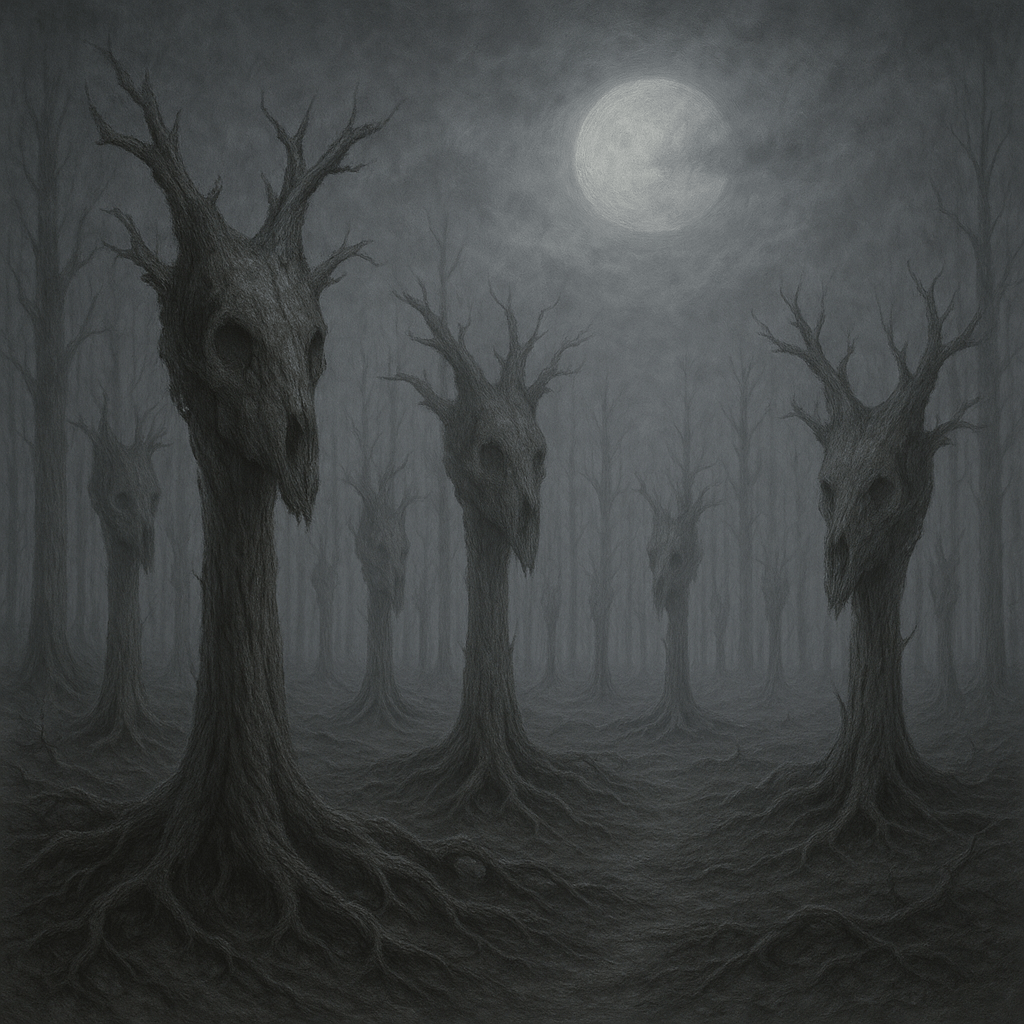
A comeback isn’t always about revival. Sometimes it’s about clarification.
25 Long Cold Black Winters marks the return of Black Winter after decades of silence, distance, and reflection. This is not an attempt to mythologise the past, nor to sanitise it—but to finally place responsibility where it belongs and to explain, plainly, who Black Winter were, who we are, and who we are not.
Where it really began
Before there was controversy, symbolism, or misinterpretation, there was pain.
Some of the founding members of Black Winter lost a parent at a formative age. Others were treated unfairly, marginalised, or ridiculed because of how they looked—long hair, black clothes, an appearance that marked them as “other” long before they had words for it. These experiences weren’t abstract; they shaped how we related to the world.
That sense of exclusion bred anger—but not nihilism. Extreme music became a way to channel that anger without destroying ourselves or others. Black metal, death metal, and the harsher edges of extreme music gave structure to emotion. Noise became language. Aggression became catharsis. What might have turned inward or outward destructively instead became sound.
Black Winter was never about hate however; it was about survival.
Metal music as shelter, not doctrine
Metal has always been a refuge. A place where social outcasts, neurodivergent people, and teenagers who didn’t fit neatly into any category could exist without apology. It was loud because silence felt unbearable. It was extreme because moderation never felt honest.
We didn’t come to metal to preach. We came to it to breathe.
Black Winter started the same way countless bands did (thankfully not like our Norwegian, second-generation counterparts); a group of teenagers trying to make sense of loss, alienation, and confusion through music. There was no ideology, no grand political vision—just riffs, atmosphere, and intensity. The theatrical darkness of black metal was part of the vocabulary of the genre, not a declaration of belief.
The role of the misdirection
Much of the early “edginess” was evidently more performative (or rather comical) than substantive in nature, manifesting in staged photographs with ketchup used as fake blood, exaggerated statements we couldn’t bear the weight of, and even the purported distribution of anti-Euronymous flyers did not come from the band collectively. It came almost entirely from a then key member of the band.
While the rest of us were focused on music—composition, mood, atmosphere—he pursued provocation for its own sake. Satanic imagery turned into fixation, and shock drifted into flirtation with National Socialist ideas. That direction was neither shared nor supported by the band.
This is precisely why we parted ways with him, following a massive fall out when an ejaculating (!) hermaphrodite baphomet found their way on one of our covers behind our back, serving as the straw that broke the camel’s back.
The decision was not ideological theatre—it was a boundary. His obsessions did not reflect who we were or what we were trying to process through music. Black Winter was about channeling inner conflict, not exporting hatred.
Xerox machines and teenage absurdity
The early days were far less dramatic than later narratives suggest. Two members’ fathers worked for the police, and in a twist of teenage practicality, police offices became part of our DIY infrastructure. Xerox machines printed thousands flyers and demo covers that circulated at the tail end of the tape-trading era.
Therefore, the Greek taxpayer sponsored our modest success in the global underground. There was no statement in that—just necessity, irony, and youth.
Missteps tied to one voice
Several moments that later followed the band trace directly back to the original singer’s unchecked lyrical control.
The photograph used for the Greece Attacks Vol. 2 compilation—showing the band holding a Greek flag (in line with the cringe manner the original ketchup session’s fashion) was taken half-jokingly as evidenced by the garden fuel (un)lit torches (!) we are also holding. This also featured in the Greek edition of Metal Hammer where the compilation was presented. In Greece, flags are found in every other house, and are omnipresent during anniversaries of independence from the Ottoman Empire and from Axis occupation. Within that cultural context, the image was mundane, almost invisible, and no different to what British bands do with the Union Jack.
But symbols change meaning when paired with narratives the band did not author, especially when a number of faux pas moments are taken together.
The song “Hellenic War” is a clear example. Built around ancient Greek projected grandeur ‘ideals’ and pagan imagery positioned against Christianity, the lyrics reflected the then singer’s personal fixation, likely channeling his beloved Dani Davey from Cradle of Filth, not a collective vision. In a Johnny Lydon–style situation (where the Sex Pistols only found out about the lyrics after the recording), the band genuinely did not fully understand the lyrical direction until well after. It wasn’t until he sent us to the printers—who refused to proceed after reviewing the litho films due to conflicts with their beliefs and values—that the seriousness of the situation became undeniable.
That moment forced reflection.
Lines we never agreed to cross
Similarly, as damaging was the inclusion of a guest lyricist who used explicitly dehumanising language. That content was never debated or endorsed collectively and stands as something we reject without qualification.
Our proximity at the time to bands associated with NSBM scenes, as well as later associations—such as Talos touring with Naer Mataron between his interrupted tenure with Black Winter—further compounded misunderstandings about our intent. The situation was further complicated by the fact that Naer Mataron’s principal figure subsequently became an MP for the far-right extremist party Golden Dawn and was later imprisoned for joining and directing a terrorist organisation. Similar associations had not been treated as problematic in other cases, including those involving figures such as Akis Kapranos (a well-known cinema critic and cousin of Franz Ferdinand’s Alex Kapranos), who has been involved with Septicflesh and Order of the Ebon Hand. Notably, Kapranos later edited himself out of Naer Mataron’s Wikipedia page following the rise of the far right in Greece, amid public backlash after the assassination of Pavlos Fyssas.
Association is not belief—but it carries consequences.
What Black Winter actually stood for
Black Winter largely comes from working-class backgrounds. Some members identify as Christian, all of us growing up as cultural Christians in a society where history, religion, and identity are deeply intertwined, and some come from historically left-wing backgrounds, an important qualification in post war Greece.
What united us was not ideology but music: emotional coldness, throat-tearing vocals rooted in Scandinavian throat-singing traditions, a focus on atmosphere, and theatrical intensity. Coming from a country that remains deeply shaped by religious conservatism—where references to God are embedded in the constitution and the Enlightenment was largely bypassed—we reject religious fundamentalism in all its forms. In line with black metal’s traditional impulse to challenge such structures, we likewise reject political extremism of any kind.
Black Winter are not aligned with, nor do promote, any political ideology—least of all those that undermine liberal democratic values and individual freedoms.
When the band reclaimed control of its direction, lyrics shifted toward philosophy—examining belief systems, power, loss, and identity rather than weaponising symbols. That shift mirrored personal growth.
The journey, not the posture
25 Long Cold Black Winters is not just detailing the band’s story—it’s a psychological journey. One shared by every member, and one familiar to countless others who felt lost at some point in their lives.
This record, and this return, are offered as a blueprint—not a prescription. Proof that anger can be transformed, that confusion can evolve into clarity, and that extreme music can be a tool for growth rather than self-destruction.
If this journey helps a marginalised teenager, or an adult revisiting old wounds, to recognise and reaffirm their own path, then those long winters served a purpose. We are mindful that people who lack the privilege of always belonging to the “in-group” can be drawn toward ideologies that flirt with antisocial tendencies, and we feel a responsibility to share our experience as both guidance, if not a cautionary tale, and safeguard.
The backdrop was extreme music. The outcome was growth. We accept missteps as cultural artifacts that ground us, and are looking forward into the future.
The winter was long, but it taught us to survive the cold; and finally… it no longer defines us.
 Winterhordes of Darkness